
At Plus Behaviour Support, our practitioners come from a variety of professional backgrounds, giving the team a rich pool of shared knowledge. What unites them, however, is their experience in and passion for the disability sector.
This breadth of experience across different roles within the sector makes our team unique and allows our practitioners to understand behaviours more deeply, ensuring plans are implementable and effective. It gives our practitioners a greater understanding of what a behaviour might be communicating, and it also helps them understand what behaviour support looks like in practice for different members of a person’s support team.
Renee, our Newcastle-based Behaviour Support Practitioner, can speak to this, having worked across the sector in multiple support roles for different organisations over the past five years.
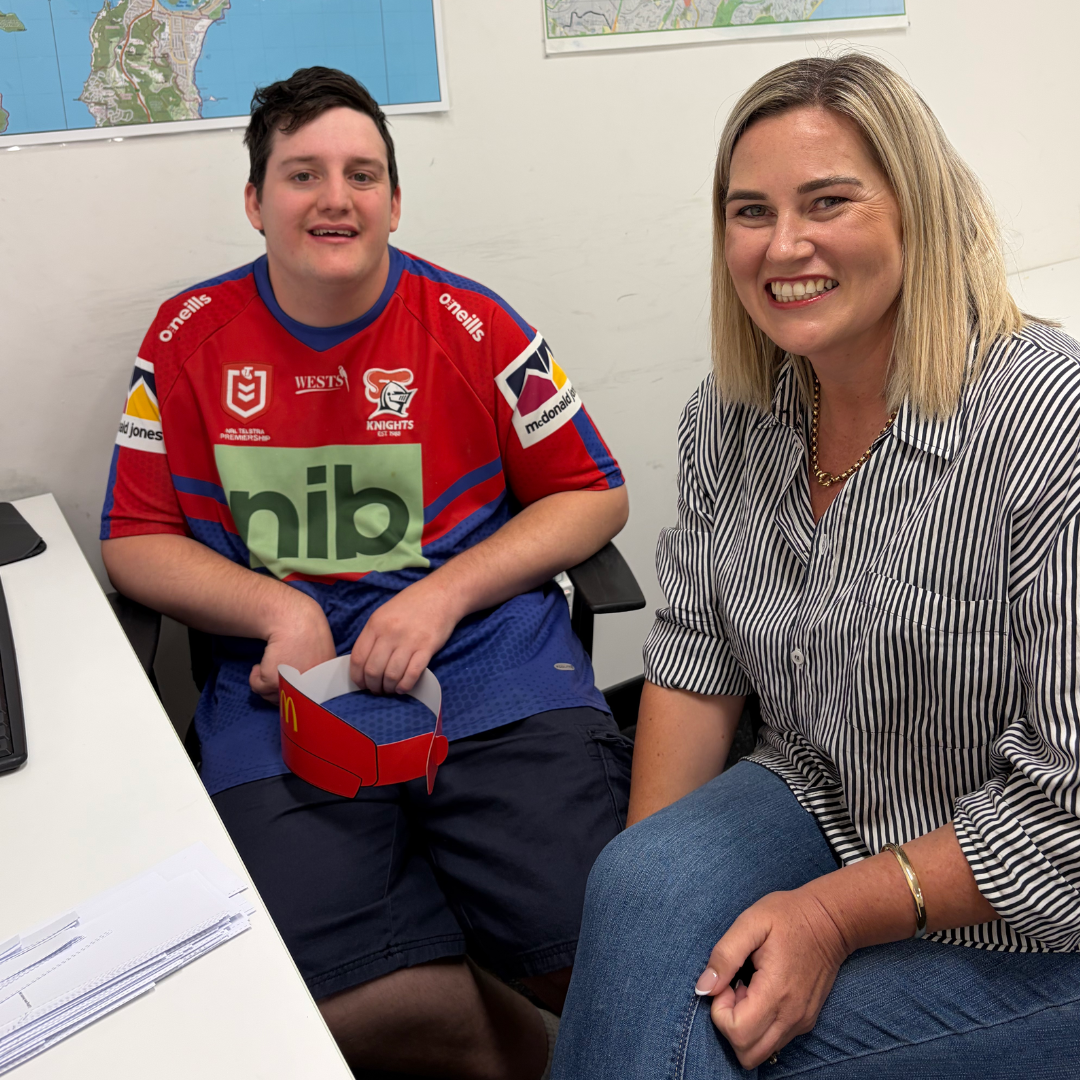
Renee’s support experience
Renee began her career in the disability sector with Australian Unity, working in aged and disability support before moving to Cerebral Palsy Alliance, where she supported people with complex medical and mobility needs across supported independent living environments.
She later joined Ability Options, gaining valuable experience supporting people with complex behaviours.
And then, four years ago, Renee joined the Newcastle team at Avenue, where she progressed from Support Worker to Lead Support Worker, then Team Coordinator, before stepping into her current role as a Behaviour Support Practitioner with Plus Behaviour Support. This broad, hands-on experience continues to shape her person-centred approach to improving quality of life.
“I’d long wanted to work in disability to do more meaningful work. When I turned 40, I took the leap and started in aged and disability support – and it has absolutely lit up my world.
“I love being a hands-on behaviour practitioner – visiting clients, supporting them day to day, and seeing what’s working and what’s challenging. Getting to know them personally means I’m involved in their lives, instead of supporting them from afar. I think by being in it with the person, you can achieve great things,” said Renee.
“I was really interested in understanding the function of behaviour, because once you understand it, you can help promote change. I also wanted to learn more about different diagnoses and how they affect day-to-day presentation, and to gain a better understanding of how to best support people with varying needs.”
Renee’s approach to better behaviour support
With a true person-first approach, she works to understand what the person is trying to communicate through a behaviour. “If we can understand what someone is trying to tell us, we can support them much more effectively,” said Renee.
Then, Renee will observe and work with the wider support team to build a plan for success.
“Having worked as a support worker myself, I know what information is actually useful when someone is reading a behaviour support plan.
“I work closely with teams and encourage them to speak openly with me so we can adapt strategies together.
“Sometimes I’ll join a shift for an hour just to see how strategies are being used and whether the team needs more support. After writing a behaviour support plan, I will often go out and observe the supports in action to see how things are working.
“I try to adapt my support to what makes the person comfortable – whether that’s the environment, the way we communicate, or how we structure appointments. Families are busy, and supporting someone with disability often adds another layer to life, so I try to be flexible and compassionate about what works best for them,” said Renee.
“Always assume positive intent”
A pillar of Renee’s approach to behaviour support is the importance of always assuming positive intent when addressing behaviours of concern.
“Assuming positive intent behind behaviour changed my whole perspective. People don’t behave negatively just for the sake of it – there’s usually something else going on. When you start from the perspective that there is a reason behind behaviour, it helps you approach support in a much more constructive way.”
She also focuses on the ‘positive’ in positive behaviour support, taking a proactive rather than reactive approach. “I’m a huge believer in positive reinforcement – making the effort to understand people rather than taking a corrective approach.
“People are very quick to tell someone what not to do, but sometimes we need to focus more on teaching what to do instead. I’ll always ask teams, ‘Can we prompt what someone should do before we prompt what they shouldn’t do? That simple shift can make a big difference.’”
By combining her frontline experience with a deep understanding of behaviour, Renee creates strategies that are not only effective but truly practical for the people implementing them every day.
“I feel really privileged to be part of people’s journeys. Seeing someone grow, build confidence, and achieve even the small things – that’s what makes this work so rewarding.”
At Plus Behaviour Support, it’s passionate practitioners like Renee – who bring experience, clinical expertise and empathy – that enable us to deliver support that is truly person-centred, practical, and impactful.
To learn more about our behaviour support services, head to our website: plusdisability.com.au/plus-clinical/